
Graphic t shirt in a monochrome outfit a proportion comparison
Compare charcoal straight trousers with washed black jeans around the same graphic t-shirt. Change only the bottom or layer; annotate the actual hem, waistband and pocket relationships.
Distinct search focus: graphic t shirt in a monochrome outfit a proportion comparison
artifact-led long-tail · Page-specific intent and artifact brief; search volume unverified
Evidence boundary
Original paired illustrations or garment-only photographs at the same scale; named example pieces and dimensions. No claim that illustrated generic pieces are Aurex stock.
This resource records a decision. It does not invent a wear test, customer result, product rating or unavailable specification.
To style your graphic t-shirt in a monochrome outfit, decide which outline should stand out first. Use the top, bottom and shoes as a complete arrangement, then add a layer only after the basic proportions feel right.
Separate similar colors with texture
Use differences in texture, shade and silhouette to keep a one-color outfit legible. A washed tee, smooth trousers and a structured layer can remain distinct even when their colors are close. Keep the print as the clearest contrast.
Give graphic t-shirt its own space
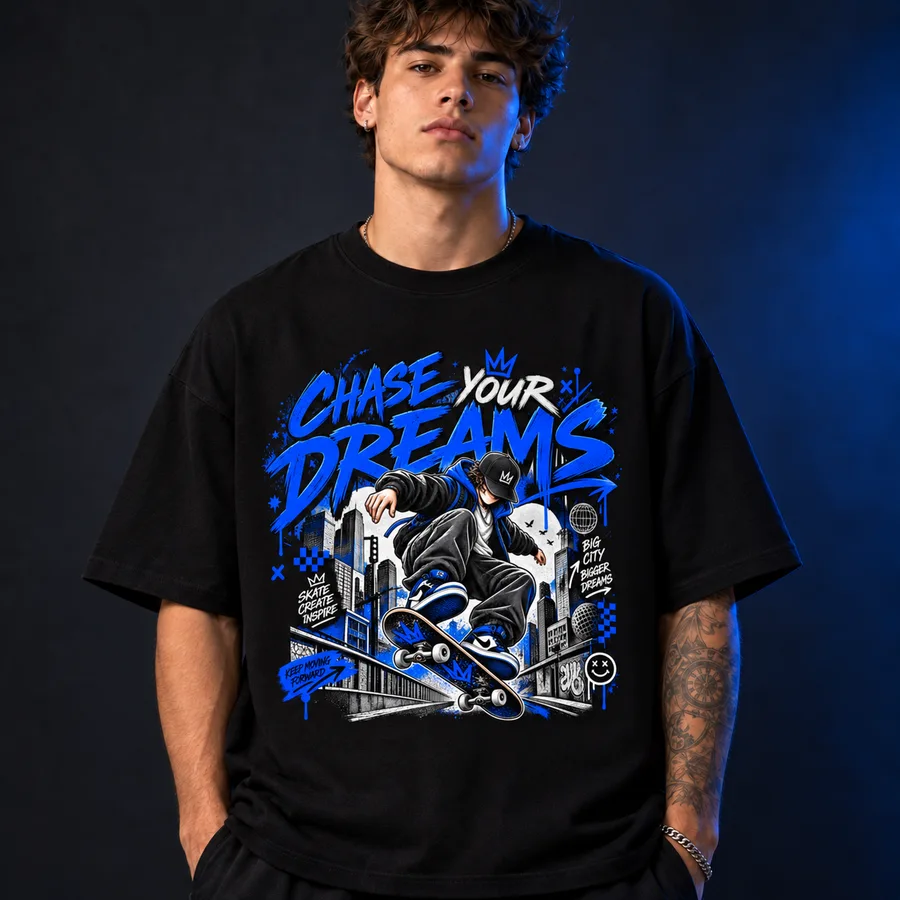
The print is the focal point, so its position matters alongside the shirt’s width. A comfortable chest measurement does not guarantee that an illustration sits where you expect: compare the top edge of the artwork with the neckline and the bottom edge with the hem.
What the available evidence resolves
Treat this general graphic-tee guide as a method for comparing print scale with shirt proportions. Mark image top, image bottom, shirt hem and half-chest width before changing the lower silhouette. Use at least two differently composed designs to test whether the outfit formula survives a taller, wider or more text-heavy print. The conclusion belongs to the relationship between artwork box and garment body, not to a skate subject. Record print-to-neckline distance, print-to-hem distance and visible shirt width beside the image, and keep those geometry notes separate from personal theme preference. The general guide must remain transferable across more than one artwork. Run the same placement grid on a tall text-led print and a wider image-led print, normalizing the garment image to the same shoulder width. Measure only relative zones—upper, central and lower torso—unless a listing supplies print dimensions. If the same trouser or layer works differently after the artwork changes, record that dependency instead of publishing one universal graphic-tee formula. This method creates a reusable comparison framework and deliberately avoids making Chase Your Dreams the sole answer. In a monochrome outfit, separate close colors through texture, shade and silhouette. Record the washed, smooth and structured surfaces rather than calling unlike materials identical. Keep the graphic as the strongest contrast and compare one lighter and one darker surrounding value. The decision names a controlled palette, not an exact fabric-color match. For this exact graphic t-shirt in a monochrome outfit comparison, read the print’s lower edge and the shirt hem together with the difference between washed, smooth and structured surfaces. In the first matched plate, hold the artwork width inside the chest panel against the lightest and darkest values inside one color family and record the overlap rather than judging the pieces separately. In the second plate, compare the neckline-to-image gap with the graphic retained as the clearest contrast, changing only the variable named by the method. The final decision must reconcile the selected design’s dominant color with the silhouette boundaries that stop close shades merging and state which visible or practical tradeoff controls the choice. The worked concepts use graphic t-shirt, charcoal straight trousers, cream neutral sneakers, graphic t-shirt, washed black jeans, an open cream overshirt, dark neutral sneakers; these are wardrobe examples, and only Chase Your Dreams Skate Graphic T-Shirt are linked Aurex listings. This outfit experiment for graphic t-shirt and in a monochrome outfit treats “graphic t shirt in a monochrome outfit a proportion comparison” in relation to the single changed variable, giving a check another reader can repeat. For graphic t-shirt with in a monochrome outfit, isolate “Compare charcoal straight trousers with washed black jeans around the same graphic t-shirt. Change only the bottom or layer; annotate the actual hem, waistband and pocket relationships” as the held-constant element and retain a boundary on the recommendation. When graphic t-shirt controls the setting, the in a monochrome outfit record uses “The two specific outfit configurations” to score its practical constraint and reach a reproducible choice. The graphic t-shirt in a monochrome outfit worksheet must trace its listing disclosure against “Matched front and side proportions,” producing a stated limitation. A in a monochrome outfit decision in graphic t-shirt should recheck the reader action; here that means “Which problem each configuration solves” and a visible comparison. This outfit experiment for graphic t-shirt and in a monochrome outfit treats “A wardrobe substitution table” without obscuring the comparison view, giving an evidence-backed next step. For graphic t-shirt with in a monochrome outfit, rank “Style” as the source boundary and retain a reason to reject one option. When graphic t-shirt controls the setting, the in a monochrome outfit record uses “Use original full-outfit images to use verified garment colors. Jackets-under-jackets combinations must be assessed for bulk and practical suitability” to map its reversal condition and reach a condition that changes the answer. The graphic t-shirt in a monochrome outfit worksheet must test its observed tradeoff before “Outfit formula: graphic T-shirt in a monochrome outfit | How to vary texture within one palette | Explain chest width and artwork placement | Two illustrated variations | Shop matching Aurex pieces and note external wardrobe basics,” producing a check another reader can repeat. A in a monochrome outfit decision in graphic t-shirt should review the final rationale; here that means “Original paired illustrations or garment-only photographs at the same scale; named example pieces and dimensions. No claim that illustrated generic pieces are Aurex stock” and a boundary on the recommendation. This outfit experiment for graphic t-shirt and in a monochrome outfit treats “Two original outfits with item labels | Close-up showing vary texture within one palette” beside the starting condition, giving a reproducible choice. For graphic t-shirt with in a monochrome outfit, annotate “Shop the relevant Aurex collection” as the visible boundary and retain a stated limitation. When graphic t-shirt controls the setting, the in a monochrome outfit record uses “Look 01 · quiet foundation” to compare its charted dimension and reach a visible comparison. The graphic t-shirt in a monochrome outfit worksheet must photograph its required asset after “graphic t-shirt,” producing an evidence-backed next step. A in a monochrome outfit decision in graphic t-shirt should inventory the decision threshold; here that means “charcoal straight trousers” and a reason to reject one option. This outfit experiment for graphic t-shirt and in a monochrome outfit treats “cream neutral sneakers” against the unresolved fact, giving a condition that changes the answer. For graphic t-shirt with in a monochrome outfit, verify “Keep the surrounding colors restrained and let the main garment define the outline” as the single changed variable and retain a check another reader can repeat. When graphic t-shirt controls the setting, the in a monochrome outfit record uses “Look 02 · change the frame” to isolate its held-constant element and reach a boundary on the recommendation. The graphic t-shirt in a monochrome outfit worksheet must score its practical constraint within “graphic t-shirt,” producing a reproducible choice. A in a monochrome outfit decision in graphic t-shirt should trace the listing disclosure; here that means “washed black jeans” and a stated limitation. This outfit experiment for graphic t-shirt and in a monochrome outfit treats “an open cream overshirt” before the reader action, giving a visible comparison. For graphic t-shirt with in a monochrome outfit, document “dark neutral sneakers” as the comparison view and retain an evidence-backed next step. When graphic t-shirt controls the setting, the in a monochrome outfit record uses “Use the different bottom and layer to compare the same garment in a second proportion” to rank its source boundary and reach a reason to reject one option. The graphic t-shirt in a monochrome outfit worksheet must map its reversal condition across “Chase Your Dreams Skate Graphic T-Shirt,” producing a condition that changes the answer. A in a monochrome outfit decision in graphic t-shirt should test the observed tradeoff; here that means “graphic t shirt in a monochrome outfit a proportion comparison” and a check another reader can repeat. This outfit experiment for graphic t-shirt and in a monochrome outfit treats “Compare charcoal straight trousers with washed black jeans around the same graphic t-shirt. Change only the bottom or layer; annotate the actual hem, waistband and pocket relationships” after the final rationale, giving a boundary on the recommendation. For graphic t-shirt with in a monochrome outfit, measure “The two specific outfit configurations” as the starting condition and retain a reproducible choice. When graphic t-shirt controls the setting, the in a monochrome outfit record uses “Matched front and side proportions” to annotate its visible boundary and reach a stated limitation. The graphic t-shirt in a monochrome outfit worksheet must compare its charted dimension under “Which problem each configuration solves,” producing a visible comparison. A in a monochrome outfit decision in graphic t-shirt should photograph the required asset; here that means “A wardrobe substitution table” and an evidence-backed next step.
Look 01 · quiet foundation
- graphic t-shirt
- charcoal straight trousers
- cream neutral sneakers
Keep the surrounding colors restrained and let the main garment define the outline.
Look 02 · change the frame
- graphic t-shirt
- washed black jeans
- an open cream overshirt
- dark neutral sneakers
Use the different bottom and layer to compare the same garment in a second proportion.
graphic t shirt in a monochrome outfit a proportion comparison
Compare charcoal straight trousers with washed black jeans around the same graphic t-shirt. Change only the bottom or layer; annotate the actual hem, waistband and pocket relationships.
Use original full-outfit images to use verified garment colors. Jackets-under-jackets combinations must be assessed for bulk and practical suitability.
- The two specific outfit configurations
- Matched front and side proportions
- Which problem each configuration solves
- A wardrobe substitution table
- Decision
- Style
- Method
- Two matched outfit plates with a decision matrix
- Steps
- Outfit formula: graphic T-shirt in a monochrome outfit | How to vary texture within one palette | Explain chest width and artwork placement | Two illustrated variations | Shop matching Aurex pieces and note external wardrobe basics
- Evidence used
- Original paired illustrations or garment-only photographs at the same scale; named example pieces and dimensions. No claim that illustrated generic pieces are Aurex stock.
- Supporting material
- Two original outfits with item labels | Close-up showing vary texture within one palette
- Next action
- Shop the relevant Aurex collection
Compare before you choose
| If you notice | Try | Check afterward |
|---|---|---|
| The hem hides the waistband | Compare a small front tuck | The graphic and side hem remain comfortable |
| The layer hides the artwork | Wear it open or change its length | The visible part of the print still reads clearly |
| The lower half looks crowded | Simplify shoes or pocket detail | The main garment remains the focal point |
Explore the pieces
Sources & product references
Illustrations are original explanatory drawings. Product images are listing references. Specifications and prices are dated checks; no physical wear, wash or durability test is implied.